Signs of Caregiver Burnout: Supporting Parents of Children who are Deaf and Hard of Hearing

Caregiver stress and parental burnout are real - and parents of children who are deaf and hard of hearing often face them in unique and compounding ways. Parents of children who are deaf and hard of hearing (DHH) often experience unique challenges throughout their child’s listening and spoken language (LSL) journey.
Did you know that 90% of families with children in the DHH community are born to hearing parents who are often faced with a period of uncertainty when receiving their child’s diagnosis? Many parents report feeling anxiety, sadness, grief, and fear when they learn of their child’s diagnosis due to its unexpected nature1. While these reactions are a normal part of adjusting to a life change, parents report their emotions are often not addressed as the focus rapidly shifts to focusing on the child’s needs and getting them the appropriate services2.
Because of this, the emotional needs of parents can become overlooked during the stressful transition. However, caregiver mental health plays an important role in the family functioning and the child’s overall development3. When parents are feeling supported, they are able to better engage in decision making, communication, and ongoing care for their child3.
Why Parent Mental Health Matters
After receiving the child’s diagnosis, parents are often tasked with learning new medical terminology, trying to understand the different hearing devices, making decisions about communication and language, navigating appointments and services, and adjusting to their new family life4.

Parents of children who are deaf and hard of hearing are shown to experience higher levels of stress, anxiety, and depression compared to parents of hearing children3. This can be attributed to the constant caregiver demands, financial strain, frequent appointments, and concerns about their child’s development, which can lead to parental burnout over time5.
Many parents feel pressure to “stay strong” for their families or quickly move into problem-solving mode rather than address their own feelings and emotions6. However, supporting caregiver mental health has shown to not only benefit the parent, but the child as well.
Impact of Stress on Parent-Child Relationships
When caregiver stress is prolonged, it can lead to burnout and other mental health challenges among parents of children who are deaf and hard of hearing. Over time, these stressors may begin to impact the family relationships within the home.

Elevated stress levels can lead parents to experience feelings of hopelessness, guilt, frustration, or emotional exhaustion, which may affect their ability to connect and engage with their child6. Unresolved grief, anxiety, and depression may contribute to insecure parent-child attachment patterns, further impacting family relationships3.
Strong parent-child relationships have been closely connected to a child’s cognitive, emotional, and language development which demonstrates its increased importance for DHH children7. Additionally, parents with prolonged stress may find it more difficult to consistently participate in therapy activities and hearing device management8. Because parental involvement is an essential factor in a child’s development, supporting caregiver mental health is beneficial in promoting positive outcomes for both children and families.
Signs of Caregiver Burnout: What to Look For
Stress can look different for every parent and caregiver. Some parents may experience physical signs of stress, while others may experience more emotional or internal responses. Parents of children who are deaf and hard of hearing have identified several common sources of stress, including3:
- Increased anxiety and worrying
- Feeling isolated from other parents or families
- Concerns about their child’s development and progress in school
- Financial concerns related to services and equipment
- Fatigue from managing appointments, school, and therapies
- Difficulty balancing caregiver demands with their personal needs
Burnout can occur after chronic physical, emotional, and mental exhaustion and can result from long-term unmanaged stress. Feelings associated with burnout include:
- Emotional exhaustion
- Detachment or withdrawal
- Reduced sense of accomplishment
Stress Management Strategies for Parents
Managing stress as a parent is not one size fits all. There is no specific protocol that will work for everyone. Ultimately, each parent is the expert on their family and should be encouraged to identify strategies that best fit their individual needs. Even small supports can make a meaningful difference in a parent's life.
Building Social Support as a Caregiver
Studies consistently show the effectiveness of social networks and connection for managing stress and burnout. Social groups and communities are shown to help parents cope during critical periods in their lives and lead to emotional empowerment among parents9.

Connecting with other parents at pick-up and drop-off is a great way to begin building a social circle with other parents who share similar experiences. Engaging in parent and family events at the CCHAT Center also provides opportunities to create meaningful social connections and support systems.
One weekly program offered at the CCHAT Center that fosters positive social connections is the Baby & Me Program. Baby & Me is a parent-focused program that supports parents of young children in building a foundation for lifelong learning, while also giving parents the opportunity to connect with other families and trained specialized staff. Although it is called Baby & Me, parents of children of all ages are welcome to attend, gather insight, and participate in discussions. This program is a great resource for community building as parents can learn from shared experience and can reduce the feelings of isolation. To get more information on the program, visit the Baby & Me Program page on the CCHAT website or reach out to CCHAT via the contact page.
Grounding Techniques
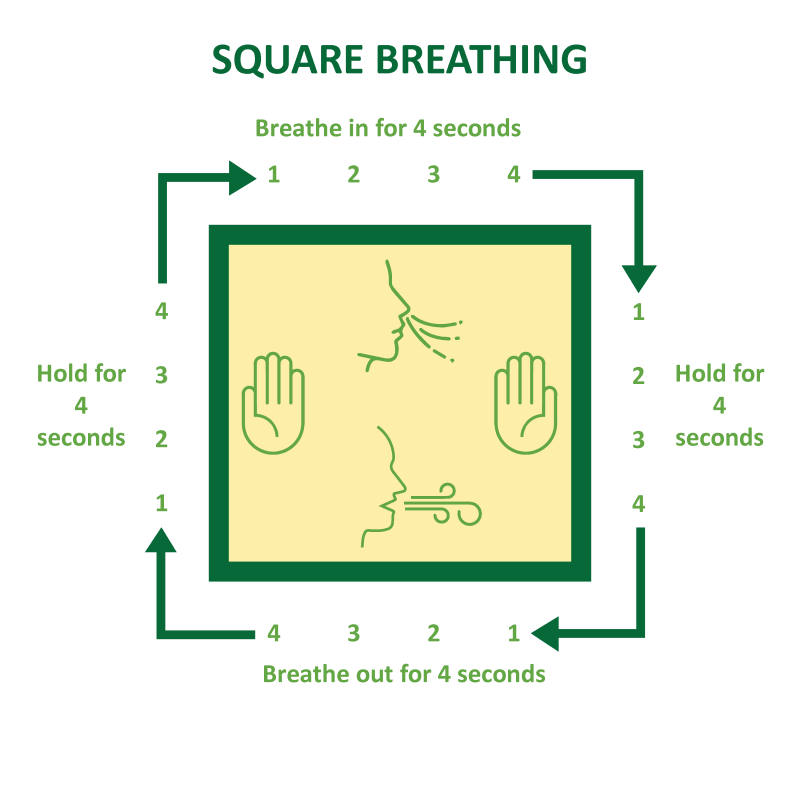
Grounding techniques have also been shown to improve emotional well-being and help manage stress during parenting10. These techniques include:
Square Breathing11
Simple breathing technique that helps calm the nervous system. Consists of inhaling for 4 seconds, holding for 4 seconds, exhaling for 4 seconds, and holding for 4 seconds before repeating
Progressive Muscle Relaxation12
Tensing and relaxing different muscle groups throughout the body to reduce physical tension and stress. Starting at the feet and slowly moving up the body, tense each muscle group for about 5 seconds before slowly releasing and relaxing the muscle.
5-4-3-2-1 Grounding10
Mindfulness strategy that uses the 5 senses to bring attention back to the present. Name 5 things you can see, 4 things you can feel, 3 things you can hear, 2 things you can smell, and 1 thing you can taste.
Journaling13
Writing down thoughts and feelings can help process emotions, identify stressors, and increase self-awareness.
Sensory Soothing
Using calming sensory input to regulate emotions and promote relaxation.
- Listening to calming music or nature sounds
- Deep pressure input (ie: weighted blanket)
- Aromatherapy (ie: lavender or peppermint)
- Fidget tools (ie: stress balls)
- Taking a warm shower or bath
- Soft textures (ie: blankets)
Resources and Support
The following resources may help parents and caregivers find information, connection, and empowerment throughout their journey.
Peer Support and Family Connection
- CCHAT Deaf Mentors and Staff: Dominique Smith, Michelle Bailey, Katie Isbell, Licia Green - These CCHAT staff are deaf themselves and navigate their own LSL journey. They can provide families with support, encouragement, and guidance through their lived experiences. Licia Green is a staff member who raised deaf twin daughters and she shares her journey with parents.
- Hearing First (https://www.hearingfirst.org/family) - Provides family-centered articles, parent stories, and resources to support families. Parents can join a family support community which allows parents to upload and read blog-style posts and questions that are answered by other parents and families with similar experiences.
- Hands & Voices (https://www.handsandvoices.org/) - Offers parent-to-parent support, shared experiences, and opportunities for connection. They have a program called “Guide By Your Side” that pairs trained parent mentors who have had similar experiences with families who are seeking support. The trained mentors are able to provide emotional support, education, and shared lived experience to help parents feel less alone in their journey.
- American Society for Deaf Children (deafchildren.org) - Provides family resources, mental health resources, community support, and educational information for families raising children who are deaf and hard of hearing.
Stress Management and Emotional Wellness Resources
- Mindful.org - Website that provides mindfulness resources, beginner friendly articles, and guided practices for stress management and meditation.
- Greater Good Science Center (https://greatergood.berkeley.edu/) - Collection of articles and expert opinions on positive practices for stress and emotional regulation.
- Self-Compassion Practices by Kristin Neff (self-compassion.org/self-compassion-practices/) - Guided self-compassion exercises and meditations that were developed from research by Dr. Kristin Neff. These exercises focus on building kindness, mindfulness, and emotional resilience.
Helpful Stress Management Mobile Apps
- Promoted Journal/Three Good Things - Daily Journal prompt app that serves as “conversation starters” for yourself. Practice gratitude with the personalized journaling app.
- Happify - Includes science-based activities and exercises rooted in positive psychology and cognitive behavioral strategies.
- Healthy Minds Program - Offers podcast-style lessons and guided mindfulness practices focused on emotional well-being.
- NatureDose - Encourages users to spend time outdoors and engage with nature to support overall wellness and stress reduction.
- Calm - Provides guided meditations, sleep stories, breathing exercises, and relaxation tools.

Written by:
Joelle Barth, OTD/S, j_pahkim@u.pacific.edu
Joelle is a third-year occupational therapy doctoral student at the University of the Pacific. She is currently in her last semester and completing her capstone project at CCHAT Center. Her work focuses on supporting and educating parents of children diagnosed deaf and hard of hearing by creating accessible resources for connection, information, and emotional support. Her professional interests include pediatric occupational therapy, mental health, and community-based support.

References
- Dikeç, G., Türk, E., Yüksel, E., Çelebi, K., & Özdemir, M. (2023). Experiences of hearing parents of children with hearing loss: A qualitative study. Children, 10(7), 1129. https://doi.org/10.3390/children10071129
- Schmulian, D., & Lind, C. (2020). Parental experiences of the diagnosis of permanent childhood hearing loss: A phenomenological study. International Journal of Audiology, 59(1), 54–60. https://doi.org/10.1080/14992027.2019.1670364
- Sealy, J., McMahon, C., & Sweller, N. (2023). Parenting deaf children: Exploring relationships between resolution of diagnosis, parenting styles and morale, and perceived child vulnerability. Journal of Child and Family Studies, 32(9), 2761–2775. https://doi.org/10.1007/s10826-023-02579-z
- Majorano, M., Guerzoni, L., Cuda, D., & Morelli, M. (2020). Mothers’ emotional experiences related to their child’s diagnosis of deafness and cochlear implant surgery: Parenting stress and child’s language development. International Journal of Pediatric Otorhinolaryngology, 130, 109812. https://doi.org/10.1016/j.ijporl.2019.109812
- Kasin, C., Muñoz, K., Ong, C., Whicker, J., & Twohig, M. (2020). Well-being of Parents of Children Who Are Deaf or Hard of Hearing. The Journal of Early Hearing Detection and Intervention, 5(1), 89–97. https://doi.org/10.26077/ptrk-5507
- Li, D., Lin, K., Cen, X., Fan, Y., Hong, L., Wu, Z., Chen, W., & Zhong, X. (2024). Psychological burden of hearing-impaired children and their parents through the covid-19 pandemic. Frontiers in Public Health, 12. https://doi.org/10.3389/fpubh.2024.1403729
- Szarkowski, A., & Dirks, E. (2021). Fathers of young deaf or hard-of-hearing children: A systematic review. The Journal of Deaf Studies and Deaf Education, 26(2), 187–208. https://doi.org/10.1093/deafed/enaa039
- Lim, T. Z., Umat, C., Chen, P.-H., Gan, C. H., & Goh, B. S. (2024). Instruments for evaluating the parental emotional status and ecological support systems among parents who considered cochlear implantation for their children with hearing loss: A scoping review. PLoS One, 19(7). https://doi.org/10.1371/journal.pone.0305748
- Zaidman-Zait, A., Curle, D., & Jamieson, J. R. (2023). Health-related quality of life among mothers of children with cochlear implants with and without developmental disabilities. Research in Developmental Disabilities, 133, 104397. https://doi.org/10.1016/j.ridd.2022.104397
- Bayot, M., Brianda, M. E., van der Straten, N., Mikolajczak, M., Shankland, R., & Roskam, I. (2024). Treating parental burnout: Impact and particularities of a mindfulness- and compassion-based approach. Children, 11(2), 168. https://doi.org/10.3390/children11020168
- Aulia, F., Zain, M., Muhlis, Ernawati, & Wulanjati, S. (2025). The Effectiveness of Relaxation Techniques in Reducing Parenting Stress in Generation Z Mothers. Al Huwiyah: Journal of Woman and Children Studies, 5(2). https://doi.org/10.24042/c57b0b98
- George, S., Govindan, R., & Kommu, J. V. (2024). Effectiveness of nurse-led progressive muscle relaxation on stress, anxiety, and depression in parents of adolescents with mental illness: A randomized controlled trial. Journal of Education and Health Promotion, 13(1). https://doi.org/10.4103/jehp.jehp_1913_23
- Toprak, B., & Sarı, T. (2023). The effects of a 2-week gratitude journaling intervention to reduce parental stress and enhance well-being: A pilot study among preschool parents. Discover Psychology, 3(1). https://doi.org/10.1007/s44202-023-00099-x

%20(1).png)


From Silence to a Sound Solution for Children With Hearing Loss. How CCHAT Prepares Them for Life.
Recent Posts
Topics
Sounds of Success
Sign Up for Our Newsletter!