Parental Advocacy for Children who are Deaf and Hard of Hearing

Navigating School Services and Supports
Parental advocacy is one of the most powerful tools families have when navigating a child's hearing loss journey. Receiving the diagnosis of deaf or hard of hearing (DHH) for your child can bring many questions and concerns about what comes next. Families are often navigating new professionals, unfamiliar devices, and big decisions that can feel overwhelming at first. Understanding available resources and developing advocacy skills can help parents feel more confident and comfortable supporting their child’s care and everyday life1.
Understanding Your Role as a Parent Advocate
Parents play a valuable role in the decision-making throughout their child’s development, as they are the ones who know the child better than anyone else. They are able to observe the child’s strengths, challenges, and interests in everyday life and have access to a different perspective that a professional may not see.
As a parent, advocacy does not mean that you have to know all the answers. Parents need to ask questions, share concerns, seek information, and work with professionals to ensure that their child’s needs are met. Parents have the right to participate in their child’s educational and healthcare decisions; therefore, it’s beneficial for parents to know the resources that are available.
Navigating Services as Your Child Grows

Children in the DHH community may have access to different services as they age and grow. During early childhood, early intervention services often include audiology services, speech-language therapy, family education, and support primarily focused on developing language, communication, listening, and foundational skills2. As children enter the school setting, educational support, self-advocacy, and accommodations become increasingly important to understand.
Transitioning between specialized programs and school can feel overwhelming, but they are a normal part of the journey. Families may encounter new support teams, educational providers, and systems that may require different processes and decisions3. Understanding the available services and knowing your rights as a parent can help make these transitions feel more manageable.
Understanding Educational Supports
As children enter school, families may become familiar with various educational plans and accommodations that are designed to support learning and communication access for their child3. Depending on their individual needs, children may qualify for supports such as an Individualized Family Service Plan (IFSP), Individualized Education Program (IEP), a Section 504 Plan, speech and language services, assistive listening technology, classroom accommodations, or specialized instruction3.
- Individualized Family Service Plan (IFSP) - outlines early intervention services for children from birth to 3 years old. They include the child’s status, resources, family’s priorities, outcomes, services, and a timeline of when the services will occur and who will provide them.
- Individualized Education Program (IEP) - outlines a customized special education plan, services, and accommodations for a student4. They include the student’s goals, services, accommodations, modifications, placement, and present levels. IEP teams are required to meet with parents at least once a year to review the student’s progress, update goals, and determine whether changes to services are needed.
- Section 504 Plan - outlines the student’s accommodations and supports to ensure equal access to education5. These may include environmental modifications, assistive technology, preferential seating, captioning services, note-taking support, and testing accommodations.
- Speech and Language Services - school speech therapy services are provided by Speech-Language Pathologists and can range from individualized pull-out sessions, group sessions, or sessions in the classroom6.
- Hearing Assistive Technology (HAT) - Digital Modulation (DM) and Frequency Modulation (FM) systems can be used in the classroom as they transmit the speaker’s voice wirelessly via a microphone to a receiver worn by the student. These are compatible with hearing aids and cochlear implants. Closed captioning in videos on the smartboard and the student’s personal devices is offered as well7.
- Classroom Accommodations - Assistive listening technology, real-time captioning, preferential seating, and visual modifications for testing and announcements8.
- Specialized Instruction - Instruction provided by a special education teacher to support a student’s individual needs. Services may be provided in a general education classroom, in small groups, or individually, based on the child’s needs
Parents are an important part of their child’s educational team and play an active role in developing and reviewing the supports their child receives. Parents have the right to review goals, ask questions, share concerns, and participate in decisions regarding services and placement for their child.
Advice from Alumni Parents
During discussions with alumni parents, they were able to offer the following insights and recommendations regarding mainstream school transitions:
- Parents have the legal right to request an IEP team meeting at any time, and the school must honor that request within 30 days. Alumni parents noted they have requested IEP team meetings with their child’s school when they had concerns and questions about their child’s services or when they wanted to know about the progress their child was making.
- A Local Education Agency (LEA) Representative is a required IEP team member who represents the school district whose primary job is to legally commit district resources and approve the services and placement needed for your child. Alumni parents recommended becoming familiar with who the LEA representative is during IEP meetings, so you know who has the authority to make decisions regarding your child's services and supports.
- Don’t be afraid to speak up for your child in the meetings! Alumni parents want to encourage new parents to trust their instincts and ask questions whenever they feel uncertain.
- Listen to your child! Transitioning to a new school can bring a variety of emotions for your child, and it may be helpful to have regular check-ins to help identify concerns. Alumni parents note that sometimes their child’s concerns greatly varied from their own, and provided a better perspective on how their child was feeling in school.
- Use your resources! Alumni parents shared that CCHAT continues to be an excellent resource even after students transition to mainstream schools. Families described reaching out to staff for guidance regarding IEP meetings, accommodations, supports, and questions that arose throughout the transition process.
How CCHAT Supports School Transitions

As families prepare for their child to enter a mainstream school setting, CCHAT staff work closely with them to ensure a smooth transition process. To guide families through educational supports and services, staff members help navigate IEP meetings, set up classroom accommodations and assistive listening technology, and collaborate directly with school personnel. CCHAT staff check in with students as they continue through mainstream school. Their goal is to equip children with the appropriate tools and services they need to thrive, setting them up for long-term success both in the classroom and beyond.
For several school districts in the Sacramento area, CCHAT students transition to their home school and continue to be served by CCHAT teachers in our itinerant/mainstream program. Due to the high demand of DHH teachers, several school districts contract with the CCHAT Center to provide their district-wide deaf and hard of hearing services. CCHAT has a team of 11 DHH teachers (and growing) that serve over 14 districts and 200+ students.
Advocacy Beyond School
Advocacy extends beyond educational settings and can help children participate fully in everyday activities. Children who are deaf and hard of hearing may also benefit from support in community and recreational settings. Sports teams, camps, extracurricular activities, and social events are great opportunities for children to develop friendships, engage socially, explore interests, and participate in their community9. Depending on the activity, accommodations may be needed to ensure children have equal access to participate. Under the Americans with Disabilities Act (ADA) and Section 504 of the Rehabilitation Act, many community organizations and programs are required to provide reasonable accommodations that allow all individuals to participate in their programs10.

Ways to advocate in these settings include communicating with coaches, activity leaders, or community organizations about your child's needs. Accommodations will vary depending on the activity and the child’s individual needs, but may include visual cues instead of auditory cues, preferential positioning, hearing assistive listening technology, written or visual instructions, captioning, or ensuring clear and accessible communication throughout the activity11. For example, in sports, advocating may involve talking with the coaches about using visual signal to communicate (e.g., raising their hand to start or stop a play instead of relying solely on a whistle), using a buddy system where a team helps relay important information, providing a pre-game preparation where rules and tactics are explained using visual aids or in a 1-on-1 environment, and promoting deaf awareness to the team to foster greater understanding and inclusion11.
The book, Time Out! I Didn't Hear You is a helpful resource that provides coaches, players, recreation staff, and families with practical strategies for supporting children who are deaf and hard of hearing in sports and recreational activities.
Teaching your children how to advocate for themselves - and modeling what it looks like to be a confident parent advocate - is also a major component in fostering independence and confidence. Children often observe their parents and the other adults around them, and parents who model confidence in asking questions and seeking support can serve as role models in their own development of self-advocacy skills12. Parents can also continue to teach their children advocacy skills by helping them understand their hearing loss, how to communicate their needs, and how to request help when they need it12. Over time, these skills can help children become more active participants in their education, relationships, and daily activities12.

Family Resources
Navigating your child's hearing loss journey does not have to be done alone. Many organizations and resources are available to help families learn about services, educational supports, advocacy, and available programs throughout their child's development. Connecting with other families who have shared similar experiences can also provide encouragement and reassurance along the way. The following resources may be helpful as you continue supporting and advocating for your child:
Education and Advocacy Resources
- California Department of Education Deaf and Hard of Hearing Programs – Information regarding educational rights, services, and supports available within California schools.
- NorCal Services for Deaf and Hard of Hearing - A non-profit organization that provides advocacy and specialized services, including camps and day programs, to individuals who are deaf or hard of hearing in the Sacramento area.
- John Tracy Center - Provides family-centered educational, support, and audiology services for children who are deaf and hard of hearing and have language delays, from birth through 18 years of age.
Community and Recreation
- Accommodations for Sports and ExtraCurricular Activities
- Time Out! I Didn't Hear You Book
- Safe, Healthy, and Happy: Practical Tips To Help Kids Who Are Deaf and Hard of Hearing Make the Most of Summer
Parent Support and Connection
- Hands & Voices (Guide By Your Side) – Parent-to-parent support and advocacy for families of children who are deaf and hard of hearing.
- Hearing First - Parents can join a family support community, which allows parents to upload and read blog-style posts and questions that are answered by other parents and families with similar experiences.
Advocating for your child is a journey that will continue to grow alongside them. With greater access and practice, parents can feel more confident in their ability to advocate and support their children in school, communities, and everyday life experiences.

Written by:
Joelle Barth, OTD/S, j_pahkim@u.pacific.edu
Joelle is a third-year occupational therapy doctoral student at the University of the Pacific. She is currently in her last semester and completing her capstone project at CCHAT Center. Her work focuses on supporting and educating parents of children diagnosed deaf and hard of hearing by creating accessible resources for connection, information, and emotional support. Her professional interests include pediatric occupational therapy, mental health, and community-based support.

References
- Terry, J., & Rance, J. (2023). Systems that support hearing families with deaf children: A scoping review. PLOS ONE, 18(11). https://doi.org/10.1371/journal.pone.0288771
- Szarkowski, A., Gale, E., Moeller, M. P., Smith, T., Birdsey, B. C., Moodie, S. T., Carr, G., Stredler-Brown, A., Yoshinaga-Itano, C., Berke, M., Binder, D., Carr, G., Cloete, N., Crace, J., Crowe, K., Dauer, F., DesGeorges, J., Dirks, E., Fellinger, J., … Holzinger, D. (2024). Family-centered early intervention deaf/hard of hearing (FCEI-DHH): Structure principles. Journal of Deaf Studies and Deaf Education, 29(SI). https://doi.org/10.1093/deafed/enad040
- Zaidman-Zait, A., Poon, B. T., Curle, D., Jamieson, J. R., & Norman, N. (2019). The transition to school among deaf/hard-of-hearing children: Teacher and parent perspectives. The Journal of Deaf Studies and Deaf Education, 24(4), 396–407. https://doi.org/10.1093/deafed/enz027
- Individuals with Disabilities Education Act (IDEA) | U.S. Department of Education. U.S. Department of Education. (n.d.). https://www.ed.gov/laws-and-policy/individuals-disabilities/individuals-disabilities-education-act-idea
- Section 504. U.S. Department of Education. (n.d.-b). https://www.ed.gov/laws-and-policy/individuals-disabilities/section-504
- Hoskin, J., Herman, R., & Woll, B. (2022). Deaf language specialists: Delivering language therapy in signed languages. The Journal of Deaf Studies and Deaf Education, 28(1), 40–52. https://doi.org/10.1093/deafed/enac029
- Reynolds, S., Miller Kuhaneck, H., & Pfeiffer, B. (2015). Systematic review of the effectiveness of frequency modulation devices in improving academic outcomes in children with auditory processing difficulties. The American Journal of Occupational Therapy, 70(1). https://doi.org/10.5014/ajot.2016.016832
- Brenner, C. R., Pandian, A. T., Hughes, S. E., Stach, C. J., Thomas, E. S., Vereb, A. F., Pleasant, T. K., Khang, E. M., & Estheimer, K. (2025). Advancing Educational Equity for Children with Hearing Loss: Celebrating the 50th Anniversary of the Individuals with Disability Education Act (IDEA). ORL-head and neck nursing: official journal of the Society of Otorhinolaryngology and Head-Neck Nurses, 43(2), 40–47.
- Beyond the Bell – Access in School Programs and Extracurriculars . Deaf Services Unlimited . (2025, October 22). https://dcedfund.org/initiative/beyond-the-bell/
- The rights of students with disabilities under the idea, Section 504, and the Ada | congress.gov | Library of Congress. Congress.Gov. (2025, September 26). https://www.congress.gov/crs-product/R48068
- Sports and deaf children: How parents can support inclusion. National Deaf Children’s Society. (2025, September 25). https://www.ndcs.org.uk/advice-and-support/real-life-stories/sports-and-deaf-children-how-parents-can-support-inclusion
- Erbasi, E., Scarinci, N., Hickson, L., & Ching, T. Y. (2016). Parental involvement in the care and intervention of children with hearing loss. International Journal of Audiology, 57(sup2). https://doi.org/10.1080/14992027.2016.1220679

%20(1).png)


From Silence to a Sound Solution for Children With Hearing Loss. How CCHAT Prepares Them for Life.
Recent Posts
Topics
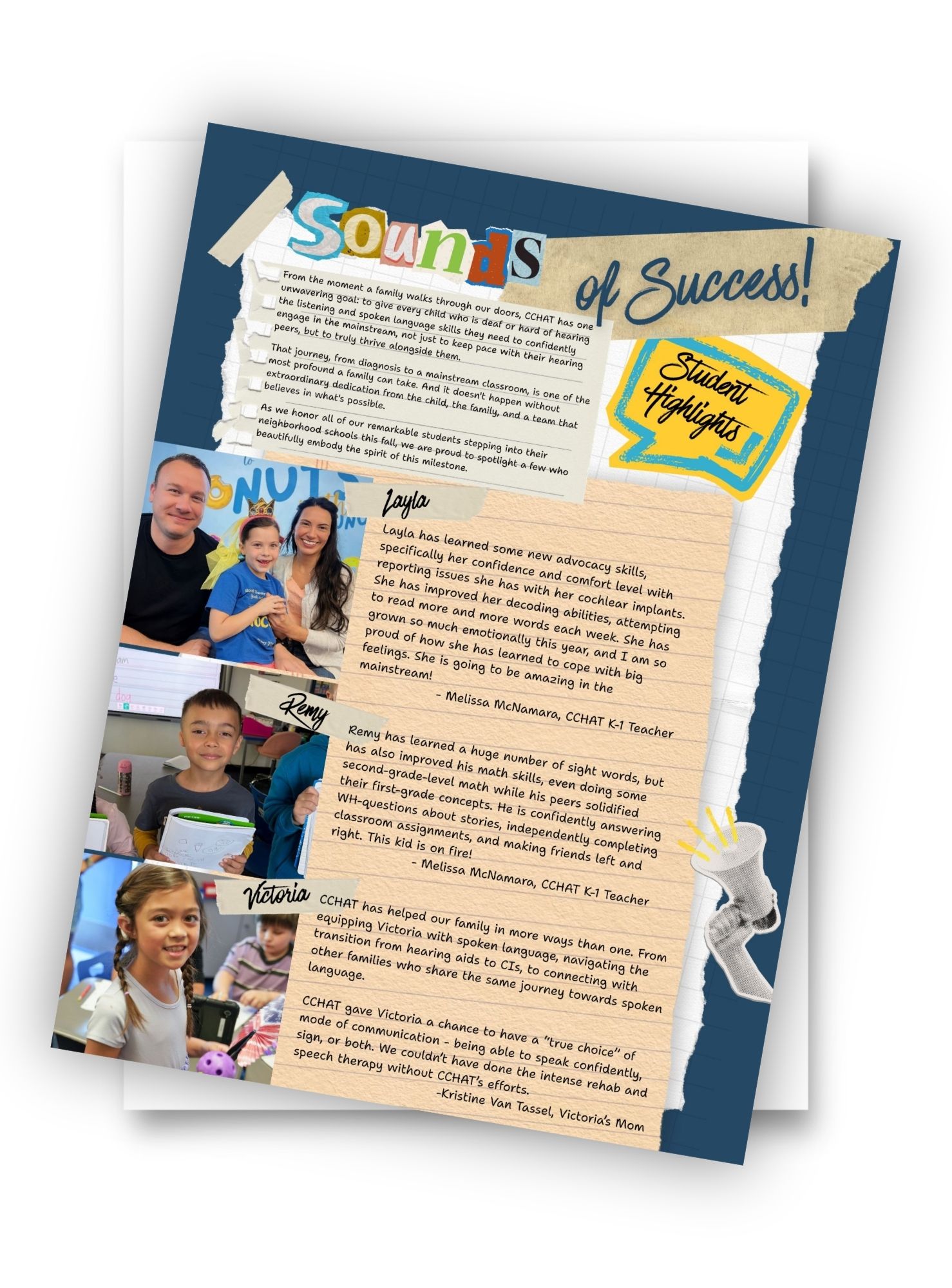
Sounds of Success
Sign Up for Our Newsletter!